 WhatsApp

Why Does Cold Water Hurt One Tooth and Not the Others?
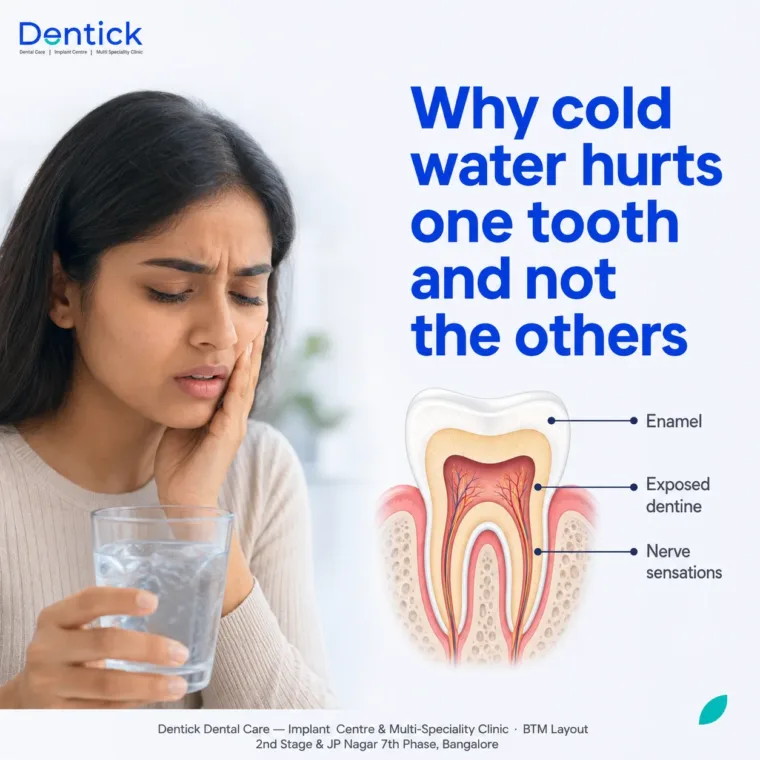
One tooth reacts to cold water and the rest do not. It is a specific enough symptom to be genuinely diagnostic. And how the pain behaves tells you more than how intense it is.
The distinction that matters is duration, and it is the first thing we ask about at either clinic.
The short answer: A short, sharp pain from cold that stops within seconds usually means exposed dentine — from gum recession, a worn filling, enamel erosion or a crack. Pain that lingers for more than 30 seconds, or comes on spontaneously, suggests the nerve is inflamed and needs assessing promptly.
Sharp, short pain usually means exposed dentine
Under the enamel sits dentine, and dentine is not solid — it is threaded with microscopic tubules running towards the nerve, each containing fluid. When enamel or gum no longer covers the dentine, cold causes that fluid to move. And the nerve interprets the movement as a sharp, brief pain.
The signature is that it is immediate, sharp, and gone within a few seconds of the stimulus being removed. That pattern is dentine hypersensitivity, and it is a plumbing problem rather than a nerve problem. It is uncomfortable but not urgent, and it is very treatable.
Constant pain is a different problem entirely
Pain that lingers after the cold is gone — thirty seconds, a minute, several minutes — is a different diagnosis. So is pain that arrives without any trigger, throbs, wakes you at night, or is worse lying down. That is pulpitis, meaning the nerve itself is inflamed, usually from deep decay, a fracture, or trauma.
Reversible pulpitis may settle if the cause is removed early. Irreversible pulpitis does not, and it progresses to a dead nerve and then an abscess, typically needing root canal treatment. This is worth acting on quickly, because the window where a filling can still save the situation closes. If you are unsure which you have, time it: a few seconds is sensitivity, a minute is not.
A worn filling can cause it
An old filling that has developed a gap at its margin lets temperature reach dentine directly. And it is one of the most common single-tooth explanations. Metal amalgam fillings conduct cold particularly efficiently.
A cracked tooth behaves similarly and is frequently missed, because a hairline crack does not show on an X-ray. The clue there is pain on releasing a bite rather than on biting down, often on something hard. Cracks matter because they propagate — caught early a crown protects the tooth. And left long enough the crack extends below the gum and the tooth cannot be saved. A recently placed filling can also be sensitive for a few weeks and then settle. Which is usually nothing to worry about.
So can gum recession
Where gum has receded, the root surface is exposed — and root surface has no enamel over it. So the dentine is directly available to cold. This is the most common cause in adults over thirty-five.
Recession comes from brushing too hard with a hard brush, from gum disease, or simply accumulates over decades. Sensitivity is often worst along the gumline of canines and premolars for exactly this reason. Enamel erosion from acidic drinks does the same thing from the other direction, thinning the enamel until dentine shows through. Both are worth identifying because the fix is different: recession from over-brushing needs technique changed before anything else, or it continues.
Worth checking before it becomes a root canal
Sensitivity is easy to live with and easy to ignore. And both of the underlying causes worth catching — a crack and early decay — are progressive.
Treatment at the sensitivity stage is minor: desensitising toothpaste with potassium nitrate or stannous fluoride used consistently for several weeks, a fluoride varnish applied in the clinic, a bonded restoration over an exposed root, or replacing a leaking filling. Treatment at the pulpitis stage is a root canal. The difference between those two is often a few months of doing nothing. If one tooth has started reacting and it was not doing so six months ago, that change is the thing worth having looked at.
What it costs at Dentick
These are our current published prices for consultation & examination at both the BTM Layout 2nd Stage and JP Nagar 7th Phase clinics. You receive the full cost in writing before any treatment begins, and the written figure is the figure. The complete list for every treatment we offer is on our published price list.
| Treatment | Cost |
|---|---|
| Consultation & examination | ₹300 – ₹800 |
Frequently asked questions
How do I know if tooth sensitivity is serious?
Time it. Sharp pain that stops within seconds of removing the cold is dentine sensitivity — uncomfortable, not urgent. Pain that lingers for thirty seconds or more, occurs without a trigger, throbs, or wakes you at night suggests nerve inflammation and should be seen promptly. Pain on biting, particularly on release, suggests a crack.
Does sensitive toothpaste actually work?
Yes, for genuine dentine hypersensitivity, but it needs consistent use — twice daily for four to eight weeks before judging it. Potassium nitrate calms the nerve response; stannous fluoride blocks the tubules. Rubbing a small amount directly onto the sensitive area with a finger and leaving it there overnight works better than brushing alone. It will not help if the cause is decay or a crack.
Why is only one tooth sensitive?
A single sensitive tooth usually points to a local cause rather than a general one: a leaking filling, a crack, localised recession, a deep cavity, or recent trauma. Generalised sensitivity across many teeth is more typically erosion, over-brushing or grinding. The fact that it is one tooth is useful information and makes it easier to find.
Can sensitivity go away on its own?
Sometimes. Sensitivity after a new filling or after a scaling usually settles within a few weeks. Sensitivity that has appeared without an obvious cause and persists beyond a month is unlikely to resolve on its own. Because the underlying exposure is still there.
Is sensitivity to hot different from sensitivity to cold?
Yes, and it is clinically significant. Sensitivity to cold is common and often benign. Pain triggered by heat, especially if it lingers or is relieved by cold water, points more strongly to an irreversibly inflamed or dying pulp and generally means root canal treatment. Heat sensitivity is the one to act on quickly.
Why are my teeth sensitive after a filling?
Some sensitivity to cold for two to four weeks after a deep filling is normal — the pulp has been irritated by the procedure and needs time to settle. Sensitivity that is worsening, that lingers for a long time after cold, or that includes pain on biting suggests the filling may be slightly high or that the pulp is more inflamed than expected. Both are quick to check, so come back rather than waiting it out.
Can whitening cause tooth sensitivity?
Yes, in around half of patients. And it is temporary — peroxide passing through the enamel briefly makes the nerve more reactive. It resolves within a few days. Starting a desensitising toothpaste with potassium nitrate a week beforehand reduces it considerably. Sensitivity that persists more than a week after whitening usually indicates something that was already present and should be examined.
Why are my teeth sensitive to sweet things?
Sensitivity specifically to sweet stimuli often points to a cavity, more so than cold sensitivity does. It can also indicate exposed dentine at the gumline or a leaking filling margin. It is a symptom worth acting on relatively promptly. Because if the cause is decay, the window in which a simple filling resolves it is finite.
Does gum recession always cause sensitivity?
No — plenty of people have visible recession with no symptoms at all. Because exposed dentinal tubules can seal themselves over time. Where it does cause sensitivity, treatment options range from desensitising toothpaste and in-clinic fluoride varnish through to bonding a restoration over the exposed root. What matters most is identifying why the recession happened, since over-brushing will otherwise continue.
Can sinus problems cause tooth sensitivity?
Yes, and it is a common source of confusion. The roots of upper back teeth sit very close to the maxillary sinus. So sinusitis can produce pain in several upper teeth at once, often worse on bending forward, and typically alongside congestion. The tell is that it affects multiple teeth rather than one. Worth mentioning if you have had a recent cold — it changes what we investigate.
Can grinding cause tooth sensitivity?
Frequently. Grinding wears through enamel to expose dentine, flexes the tooth at the gumline creating sensitive notches. And irritates the pulp through sustained overload. Sensitivity that is worst in the morning is a useful clue. In that situation treating the sensitivity alone will not hold — the grinding has to be addressed, usually with a night guard.
When should I see a dentist about sensitive teeth?
If it has recently started, if it is getting worse, if it lingers more than thirty seconds, if it wakes you at night, if it is triggered by heat, or if there is pain on biting. Any of those changes it from a comfort issue to something worth diagnosing. Sensitivity that has been stable for years and responds to desensitising toothpaste can reasonably be mentioned at your next check-up.
If one tooth has recently started reacting to cold, it is worth a look — the treatments available at this stage are minor. And they stop being minor if the cause turns out to be a crack or decay. Consultations start at ₹300.
Related reading
- Evening Dental Appointments in South Bangalore — Open Until 8:30pm, Seven Days
- Afraid of the Dentist? Read This Before You Cancel Another Appointment
- Spit, Don't Rinse: The Three-Second Brushing Habit That Changes Everything
Book an appointment in BTM Layout or JP Nagar
Dentick Dental Care runs two clinics in South Bengaluru — BTM Layout 2nd Stage and JP Nagar 7th Phase. Open 24 hours, seven days a week. Consulting sessions run 11am–2pm and 5pm–8:30pm — book within those and you will be seen without waiting. Walk-ins and emergencies are attended at any hour, with a short wait outside session times. Evening sessions mean you do not need to take a weekday morning off. Read more about this treatment.
Call or WhatsApp +91 93538 45416 to book. Consultations start at ₹300 and include a written treatment plan with exact costs. We also serve patients from Koramangala, HSR Layout, Jayanagar, Bannerghatta Road, Arekere, Bommanahalli and Gottigere.
Have a question about your dental health? Ask us — no appointment needed, and it costs nothing.