 WhatsApp

Spit, Don’t Rinse: The Three-Second Brushing Habit That Changes Everything
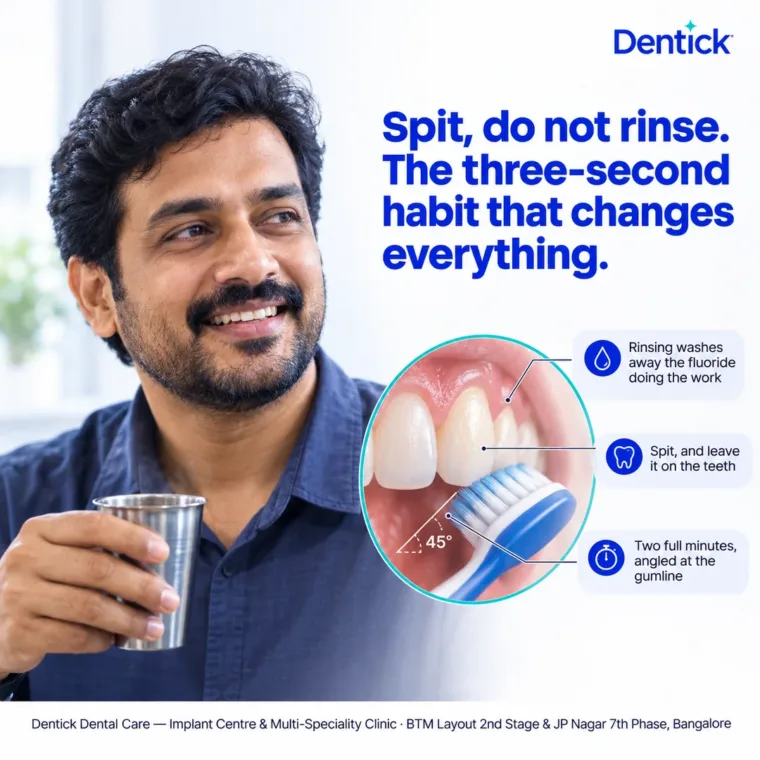
Almost everyone in India rinses after brushing. It feels like finishing the job. It is, in fact, undoing most of it.
Fluoride toothpaste works by leaving a concentrated layer of fluoride on the enamel surface, where it continues remineralising for hours. A mouthful of water removes that layer within three seconds. This is the cheapest improvement available in dentistry. And it is the first thing we mention at check-ups at both our clinics.
The short answer: After brushing, spit out the excess toothpaste but do not rinse with water. Rinsing washes away the concentrated fluoride that protects enamel for hours afterwards. This single change measurably reduces decay and costs nothing.
Rinsing washes away the fluoride doing the work
The active ingredient in toothpaste is not the foam and it is not the flavour — it is fluoride, usually at 1,000 to 1,500 parts per million. It works by being present on the tooth surface over time, converting hydroxyapatite in enamel to the more acid-resistant fluorapatite and helping remineralise early decay before it becomes a cavity.
What that process needs is contact time. Two minutes of brushing delivers the fluoride; the hours afterwards are when it does its work. Rinsing with water immediately afterwards dilutes it to almost nothing and flushes it away. You have done the mechanical cleaning and thrown away the chemical protection — which for many people is the difference between a filling and no filling.
Spit, and leave it on the teeth
The habit to build: brush for two minutes, spit out the excess thoroughly, and stop. No water, no cup, no mouthwash. It feels wrong for about a week and then feels normal.
Two related points. Do not use mouthwash straight after brushing either — most rinses contain far less fluoride than your toothpaste. So you are replacing a strong dose with a weak one. Use mouthwash at a different time of day if you use it at all. And the pea-sized amount you were taught as a child is correct for adults too. A full brush-head of paste mostly ends up in the sink.
Wait 30 minutes after anything acidic
This one is counter-intuitive and it applies after anything acidic — citrus, cola, wine, vinegar. And in Bangalore especially, lemon in water first thing in the morning.
Acid temporarily softens the enamel surface. Brushing while it is softened physically scrubs away a microscopic layer of enamel that would otherwise have recovered on its own within about thirty minutes, as saliva neutralises the acid and re-hardens the surface. Over years, brushing straight after acidic drinks is a significant cause of the enamel erosion we see on the inner surfaces of upper front teeth. Rinse with plain water if you want to, wait half an hour, then brush.
Two full minutes, angled at the gumline
Two full minutes, which is roughly four times longer than most people actually brush. Split it into quadrants and give each thirty seconds — an electric brush with a timer does this for you. And it is the main reason electric brushes outperform manual ones in studies.
Angle matters as much as duration. Point the bristles at 45 degrees into the junction between tooth and gum, not flat against the tooth face. That junction is where plaque accumulates and where gum disease starts. And it is the area a straight-on scrub misses entirely. Small circular movements, not a horizontal saw. And brush the inner surfaces of the lower front teeth properly — that is where tartar forms fastest. Because a salivary gland duct opens right there.
Technique matters more than an expensive brush
People spend ₹8,000 on a brush and keep rinsing afterwards. A ₹40 manual brush used with correct technique, held at the gumline for two minutes. And followed by spitting rather than rinsing will outperform an expensive brush used badly.
The genuine advantages of an electric brush are the built-in timer and the fact that it does the movement for you, which helps anyone with limited dexterity or arthritis. Beyond that, choose soft bristles — medium and hard cause gum recession and abrasion at the neck of the tooth. And we see the damage regularly. Replace the brush every three months, or sooner once the bristles splay. A splayed brush cleans almost nothing at the gumline.
What it costs at Dentick
These are our current published prices for scaling & polishing at both the BTM Layout 2nd Stage and JP Nagar 7th Phase clinics. You receive the full cost in writing before any treatment begins, and the written figure is the figure. The complete list for every treatment we offer is on our published price list.
| Treatment | Cost |
|---|---|
| Scaling & polishing (full mouth) | ₹800 – ₹2,000 |
Frequently asked questions
Should I really not rinse after brushing?
Correct — spit out the excess toothpaste and stop there. This is the standard recommendation from the UK's NHS and is supported by evidence showing measurably lower decay rates in people who do not rinse. If the taste bothers you, it fades within a couple of weeks of changing the habit.
Should I brush before or after breakfast?
Before, if breakfast includes anything acidic — fruit, juice, coffee, curd. Brushing beforehand removes overnight plaque and leaves a fluoride layer in place before the acid arrives. If you prefer to brush after eating, wait thirty minutes.
Is flossing better before or after brushing?
Before. Flossing first disturbs plaque between the teeth so the fluoride in your toothpaste can reach those surfaces. And there is trial evidence that flossing-then-brushing leaves higher fluoride levels between teeth than the reverse. An interdental brush is easier than floss for most adults and often cleans better — we can show you the right size at your check-up.
How hard should I be brushing?
Much more gently than most people do. If your bristles splay within a month, you are scrubbing too hard. Hard brushing causes gum recession and wears a notch into the neck of the tooth. And neither of those grows back. Plaque is soft and comes off with light pressure — it is technique and time that remove it, not force.
Do I need mouthwash?
Most people with healthy gums do not. It does not replace brushing or interdental cleaning. Where it helps is a specific prescribed course — chlorhexidine after gum treatment or surgery, for example — used for the duration advised and then stopped, since long-term use stains teeth. If you use a daily fluoride rinse, use it between meals rather than straight after brushing.
What fluoride concentration should my toothpaste have?
At least 1,350 to 1,500 parts per million for adults — check the packaging. Because some products sold as natural or herbal contain no fluoride at all and offer no protection against decay. Children under three need a smear of 1,000ppm paste; from three to six, a pea-sized amount. If you have a high decay rate, we may prescribe a 5,000ppm paste. Which is used exactly like ordinary toothpaste but is considerably more protective.
How much toothpaste should I actually use?
A pea-sized amount, for adults as well as children. The full brush-head shown in advertising mostly ends up in the sink and does nothing extra — the fluoride concentration is what matters, not the volume. Using less also makes it easier to spit out the excess thoroughly without being tempted to rinse.
Is it safe for children not to rinse after brushing?
Yes, and it is specifically recommended. Children should spit out the excess and not rinse, exactly as adults should — the fluoride left on the teeth is doing the protective work. What matters for young children is the amount of paste: a smear under three and a pea-sized amount from three to six, with brushing supervised so it is not swallowed in quantity.
Does this advice apply if I use non-fluoride toothpaste?
The rinsing advice exists because of the fluoride. So with a non-fluoride paste there is nothing being left behind to protect the tooth. The more useful conversation is why you are using one. Fluoride is the single best-evidenced preventive agent in dentistry. And if the concern is about safety at toothpaste concentrations, that is worth discussing rather than avoiding — the evidence base is very large.
Does oil pulling work?
There is no reliable evidence that it removes plaque, prevents decay or treats gum disease. And it is not a substitute for brushing or interdental cleaning. It is unlikely to cause harm in itself. The risk is entirely in what it replaces — patients who adopt it instead of proper brushing and scaling arrive with the same tartar and the same gum disease as anyone else, but later.
Should I brush after every meal?
Twice a day thoroughly is the standard, and doing it well matters far more than doing it often. Brushing straight after an acidic meal or drink actively causes harm, because softened enamel is scrubbed away — wait thirty minutes. If you want to clean up after lunch, rinsing with plain water or chewing sugar-free gum stimulates saliva and does the job without abrading anything.
Does drinking water after brushing count as rinsing?
Effectively, yes, if you do it immediately. Try to leave fifteen to twenty minutes between brushing and drinking anything, which gives the fluoride time to act on the enamel surface. The most practical fix is to brush last thing at night after you have finished eating and drinking for the day — that gives the fluoride the longest possible undisturbed contact time.
If your gums bleed when you brush, technique alone will not fix it — that needs looking at. Book a check-up at either clinic. A consultation starts at ₹300 and includes a proper look at how you are cleaning, not just what needs treating.
Related reading
- Does Teeth Scaling Loosen Your Teeth? What Dental Scaling Really Does
- Waking Up With a Sore Jaw? You May Be Grinding Your Teeth at Night
- Why Does Cold Water Hurt One Tooth and Not the Others?
Book an appointment in BTM Layout or JP Nagar
Dentick Dental Care runs two clinics in South Bengaluru — BTM Layout 2nd Stage and JP Nagar 7th Phase. Open 24 hours, seven days a week. Consulting sessions run 11am–2pm and 5pm–8:30pm — book within those and you will be seen without waiting. Walk-ins and emergencies are attended at any hour, with a short wait outside session times. Evening sessions mean you do not need to take a weekday morning off. Read more about this treatment.
Call or WhatsApp +91 93538 45416 to book. Consultations start at ₹300 and include a written treatment plan with exact costs. We also serve patients from Koramangala, HSR Layout, Jayanagar, Bannerghatta Road, Arekere, Bommanahalli and Gottigere.
Have a question about your dental health? Ask us — no appointment needed, and it costs nothing.