 WhatsApp

Does Teeth Scaling Loosen Your Teeth? What Dental Scaling Really Does
Ask around in Bangalore and you will hear it stated as fact: get your teeth cleaned and they will start to wobble. It is repeated confidently by people who have never had it done. And it is the single most common reason patients at our BTM Layout and JP Nagar clinics delay a treatment that would have taken forty minutes.
The belief is not invented out of nothing. Something does change after a scaling, and people notice it. But the explanation is close to the opposite of what the myth claims — and understanding why matters. Because the delay this myth causes is measured in lost teeth.
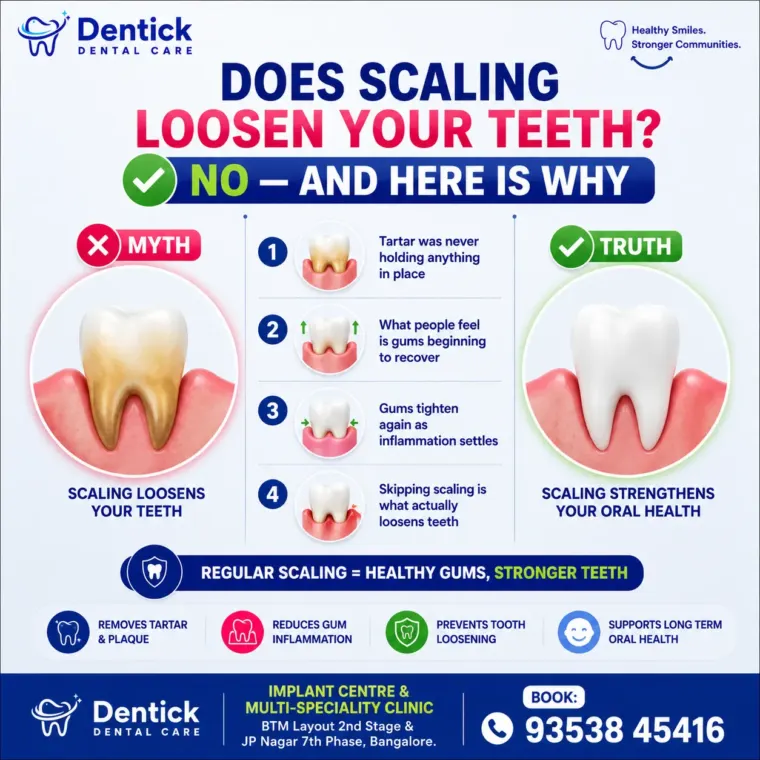
The short answer: No. Teeth scaling does not loosen teeth. Tartar is a hard deposit sitting on the tooth surface, not a structural support. The sensation people notice afterwards is gum tissue beginning to shrink back to a healthy state as inflammation resolves. And it settles within one to two weeks.
Tartar was never holding anything in place
Tartar, or calculus, is mineralised plaque. It forms when soft bacterial plaque is left undisturbed long enough for minerals in saliva to harden it, usually starting along the gumline and behind the lower front teeth. Once hardened, no amount of brushing removes it.
The crucial point is where it sits: on the outside of the tooth, above and just below the gum margin. It is a crust on a surface, not a filling in a gap. It has no attachment to bone, no role in the periodontal ligament that actually holds a tooth in its socket, and no load-bearing function whatsoever. Removing it takes away a deposit. It cannot take away support that was never there.
What people feel is gums beginning to recover
Here is what people are genuinely feeling. Tartar is porous and holds bacteria hard against the gum. And the body responds with chronic inflammation — the gum swells, becomes engorged with blood, and presses tightly around the tooth. That swelling creates a sensation of firmness.
Take the tartar away and the inflammation begins to resolve. The gum deflates, the swelling reduces, and the tooth suddenly feels less gripped than it did the week before. That is recovery being mistaken for damage. The tooth has not moved; the swollen tissue around it has reduced. Sensitivity to cold for a few days follows the same logic — root surface that was covered by tartar is briefly exposed to temperature again.
Gums tighten again as inflammation settles
Give it one to two weeks. As inflammation settles, healthy gum tissue tightens back against the tooth surface and the gap that tartar was holding open begins to close. Most patients who were alarmed on day two report nothing unusual by day fourteen.
What helps this along is brushing properly at the gumline in that period, which many people avoid precisely because the area feels tender. Gentle, angled brushing is exactly what the tissue needs. If you have been advised to use a prescribed mouthwash for a short course afterwards, use it for the full course and then stop — the long-term work is done by the brush, not the rinse.
Skipping scaling is what actually loosens teeth
This is the part the myth gets exactly backwards. Tartar left in place keeps bacteria pressed against the gum indefinitely. Chronic inflammation moves from the gum into the periodontal ligament and then into the bone that holds the tooth. That bone does not grow back.
Teeth genuinely do loosen in advanced periodontitis — and by then the options have narrowed to deep cleaning under anaesthetic, splinting, or extraction. Every one of those cases began as bleeding gums and visible tartar that somebody decided not to have cleaned. A scaling every six to twelve months, which takes under an hour and starts at ₹800 here, is the entire intervention that prevents it.
What it costs at Dentick
These are our current published prices for scaling & polishing at both the BTM Layout 2nd Stage and JP Nagar 7th Phase clinics. You receive the full cost in writing before any treatment begins, and the written figure is the figure. The complete list for every treatment we offer is on our published price list.
| Treatment | Cost |
|---|---|
| Scaling & polishing (full mouth) | ₹800 – ₹2,000 |
Frequently asked questions
What is teeth scaling exactly?
Scaling is the removal of hardened plaque — tartar — from the tooth surface, above and just below the gumline, using an ultrasonic scaler that vibrates the deposit away with water irrigation. Polishing usually follows, which smooths the surface so new plaque takes longer to accumulate. It is a cleaning procedure, not a surgical one, and it does not remove or reshape tooth structure.
Does dental scaling remove enamel?
No. An ultrasonic scaler works at a frequency tuned to fracture calculus, which is far more brittle than enamel. It is designed to leave the tooth untouched. Aggressive scrubbing with an abrasive toothpaste at home does more surface damage over a year than a professional scaling does.
How often should I get my teeth scaled?
Every six months for most adults. Every three to four months if you smoke, have diabetes, have had gum disease treated before, or build tartar unusually quickly. Some people genuinely can go a year. The honest answer is that we tell you at your check-up based on what is actually on your teeth, rather than sending a blanket reminder.
Is scaling painful?
For most people, no — it is vibration and water rather than pain, and no anaesthetic is needed. If your gums are already inflamed it can be tender. And if there are deep pockets requiring root planing below the gumline we will numb the area first. Tell us if you are sensitive; slowing down and working in sections makes a considerable difference.
Will scaling create gaps between my teeth?
Occasionally a gap becomes visible after scaling — but it was already there, filled with tartar and hidden by swollen gum. This is more noticeable when cleaning has been delayed for years. It is not a gap the scaling created. And where it reflects genuine gum recession from long-standing disease, the alternative was continuing to lose bone.
How long does a scaling appointment take?
Thirty to forty-five minutes for most people, including polishing. If there is heavy tartar built up over several years, or if deep pockets need root planing below the gumline, it may be split across two appointments and done by quadrant under local anaesthetic. We will tell you which you need after looking, rather than booking you in blind. Our evening sessions run to 8:30pm seven days a week, so a scaling fits comfortably into an after-work slot.
Will scaling make my teeth whiter?
It removes surface stain from coffee, tea, turmeric and tobacco, which for many people is most of the discolouration they were unhappy with — so yes, teeth usually look noticeably lighter afterwards. What it does not do is change the natural underlying colour of the tooth, which is what whitening addresses. A useful sequence if you are considering whitening: have the scaling first, then decide. A meaningful number of patients find they no longer want the whitening once the stain is gone.
Can I eat straight after teeth scaling?
Yes, though if a fluoride varnish has been applied we will ask you to avoid hard or hot food for a few hours. Gums may be tender for a day or two. So very hot, very cold and highly acidic items are best avoided initially. If you had root planing under local anaesthetic, wait until the numbness has fully worn off before eating — biting a numb cheek or lip is easy to do and genuinely painful afterwards.
Why do my teeth feel rough or sensitive after scaling?
Roughness usually means polishing has not been done yet, or that a small amount of stubborn deposit remains — mention it and we will address it. Sensitivity to cold for a few days is common and expected: root surface that was covered by tartar is briefly exposed to temperature again. And it settles as the gum tightens back. A desensitising toothpaste with potassium nitrate helps in the meantime. Sensitivity lasting beyond two weeks is worth reporting rather than tolerating.
Do I still need scaling if I brush twice a day?
Yes. Brushing removes soft plaque, but once plaque mineralises into tartar it bonds to the tooth surface and no brush will shift it. Tartar forms fastest behind the lower front teeth and around the upper molars, where salivary ducts open. And it forms in everyone to some degree regardless of technique. Good brushing lengthens the interval between scalings considerably — it does not remove the need for them.
What is the difference between scaling and root planing?
Scaling removes deposits from the crown of the tooth and just below the gum margin. Root planing goes deeper, cleaning and smoothing the root surface inside a periodontal pocket where the gum has detached from the tooth. Root planing is treatment for established gum disease rather than routine maintenance, it is usually done under local anaesthetic by quadrant, and it costs more. Pocket measurements at your examination are what determine which one you actually need.
How much does teeth scaling cost in Bangalore?
Scaling and polishing for the full mouth starts at ₹1,500 at both our BTM Layout and JP Nagar clinics. And the exact figure appears on the price list published on this site. Deep cleaning or root planing for gum disease is priced per quadrant and costs more. You get the cost in writing before we start. And if a routine scaling is genuinely all you need, that is what you will be charged for.
If it has been more than a year, or if your gums bleed when you brush, book a check-up rather than a cleaning — that way we look first and tell you what you actually need. A consultation at Dentick starts at ₹300, and we will say plainly if nothing needs doing.
Related reading
- Spit, Don't Rinse: The Three-Second Brushing Habit That Changes Everything
- Why Are My Gums Bleeding? Causes, Treatment and When to Worry
- "If It Doesn't Hurt, Nothing Is Wrong" — The Most Expensive Belief in Dentistry
Book an appointment in BTM Layout or JP Nagar
Dentick Dental Care runs two clinics in South Bengaluru — BTM Layout 2nd Stage and JP Nagar 7th Phase — open 11am–2pm and 5pm–8:30pm, seven days a week including Sunday. Evening appointments mean you do not need to take a weekday morning off. And we answer the phone 24/7 for genuine emergencies. Read more about this treatment.
Call or WhatsApp +91 93538 45416 to book. Consultations start at ₹300 and include a written treatment plan with exact costs. We also serve patients from Koramangala, HSR Layout, Jayanagar, Bannerghatta Road, Arekere, Bommanahalli and Gottigere.
Have a question about your dental health? Ask us — no appointment needed, and it costs nothing.