 WhatsApp

“If It Doesn’t Hurt, Nothing Is Wrong” — The Most Expensive Belief in Dentistry
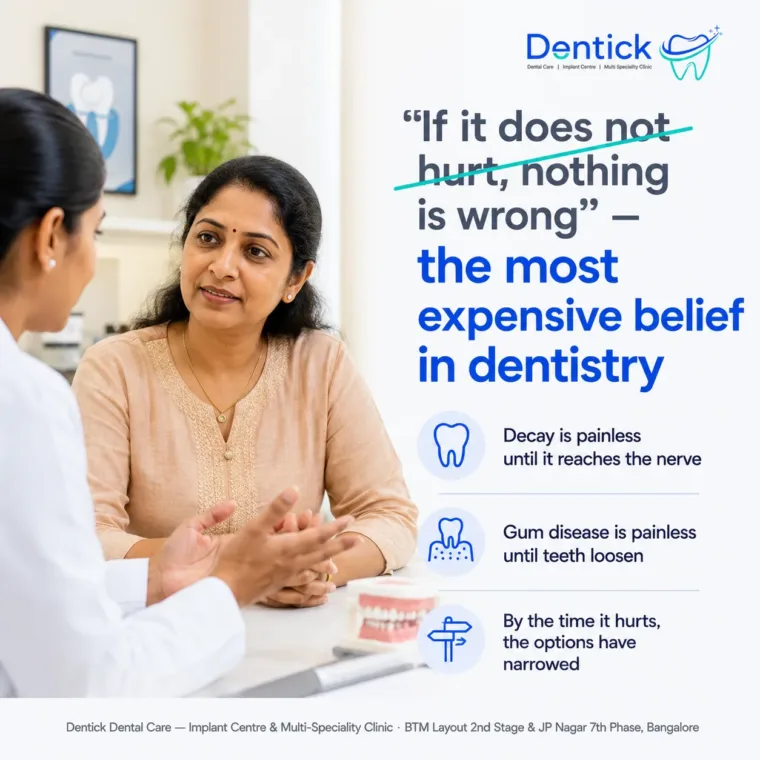
It is a completely reasonable heuristic for most of the body. If something hurts, attend to it; if it does not, carry on. Applied to teeth, it is the belief that costs Indian patients the most money and the most teeth.
The reason is structural, not behavioural. The two conditions that actually destroy teeth give almost no warning until they are well advanced.
The short answer: Both of the conditions that cost people their teeth — decay and gum disease — are painless until they are advanced. Pain in dentistry is a late warning sign, not an early one. By the time a tooth hurts, the range of treatment options has usually narrowed and become more expensive.
Decay is painless until it reaches the nerve
Enamel has no nerve supply at all. Decay can progress through the entire thickness of it without producing any sensation whatsoever — which for a slow-moving cavity can take a year or more.
Once it reaches the dentine underneath, you may notice mild sensitivity to sweet or cold. Many people do not. Pain arrives when the decay reaches the pulp. And by that point you are not choosing between a filling and no filling — you are choosing between a root canal and an extraction. The window in which a small filling would have solved it entirely closed silently, months earlier. This is exactly what an X-ray at a check-up finds: decay between teeth, invisible from the surface, at a stage where it is still a twenty-minute appointment.
Gum disease is painless until teeth loosen
Gum disease is worse in this respect, because it destroys bone painlessly. Gingivitis produces bleeding, which people dismiss. Periodontitis produces pocketing and bone loss, which produces nothing you can feel at all.
The first symptom most patients actually notice is a tooth becoming mobile — and mobility means the supporting bone has already gone. It does not grow back. This is why gum disease, rather than decay, is the leading cause of adult tooth loss. And why bleeding when you brush is worth acting on despite being painless and common. Measuring pocket depths takes a few minutes at a check-up and is the only way to know where you stand.
By the time it hurts, the options have narrowed
At every stage, waiting narrows what is possible. Early decay: a filling. Deeper decay: a root canal and a crown. Decay into the root: extraction, then an implant or bridge to replace it.
Each step up that ladder costs several times the one before and involves more of your time. The same applies to gums: a scaling from ₹800, versus root planing under anaesthetic, versus flap surgery, versus losing teeth and replacing them. Nobody chooses to be on the expensive rung. They arrive there by using pain as the trigger to seek treatment, which reliably delivers them to the point where the cheap options have expired.
Six-monthly checks exist for exactly this reason
A check-up is not a formality and it is not primarily about cleaning. It is a survey for things that are actively progressing and cannot be detected by the person they are happening to.
What we are looking at: bitewing X-rays for decay between teeth, pocket depths around each tooth for bone loss, existing fillings and crowns for failing margins, wear patterns indicating grinding. And a soft tissue examination of the tongue, cheeks and floor of the mouth for anything abnormal — which matters considerably in India given the incidence of oral cancer. Most of that is invisible to you and painless. Six months is the standard interval because it is roughly how long it takes for something small to become something significant.
What it costs at Dentick
These are our current published prices for consultation & examination at both the BTM Layout 2nd Stage and JP Nagar 7th Phase clinics. You receive the full cost in writing before any treatment begins, and the written figure is the figure. The complete list for every treatment we offer is on our published price list.
| Treatment | Cost |
|---|---|
| Consultation & examination | ₹300 – ₹800 |
Frequently asked questions
How often should I get a dental check-up?
Every six months for most adults. More often — three to four monthly — if you smoke, have diabetes, have had gum disease treated, or build tartar quickly. Some people with excellent oral health can safely go a year. We will tell you what interval suits you rather than sending a default reminder.
What happens at a dental check-up?
An examination of every tooth, X-rays where indicated to see between teeth and below existing fillings, gum pocket measurements, a check of existing restorations, an assessment of wear and bite, and a soft tissue examination. You leave with a written treatment plan and costs if anything needs doing, and a clear statement if nothing does.
Do I need X-rays every time?
No. Bitewing X-rays are typically taken every one to two years for adults with a low decay risk, more often if risk is higher. They are the only way to see decay starting between teeth. Which is where a large proportion of adult cavities begin and where nothing is visible on examination alone. Doses from modern digital dental X-rays are very small.
My teeth feel fine. Is a check-up really necessary?
That is exactly the situation check-ups are designed for. Feeling fine rules out advanced disease. It does not rule out early decay or bone loss, both of which are painless. The value of the appointment is in finding things while they are still small — and in being told plainly when nothing needs doing, which is a common outcome.
How much does a check-up cost at Dentick?
A consultation starts at ₹300 and includes the examination and a written treatment plan with exact costs for anything recommended. Phone and WhatsApp advice costs nothing. Consultations during late-night emergency hours are ₹500. There is no obligation to proceed with any treatment discussed.
How much do dental X-rays cost and are they safe?
Costs appear on the price list published on this site. Modern digital dental X-rays deliver a very small dose — a set of bitewings is a small fraction of the background radiation you receive naturally each year. They are only taken where clinically indicated, typically every one to two years for adults with low decay risk. They are the only way to see decay starting between teeth, which is where a large proportion of adult cavities begin.
What is an oral cancer screening and do I need one?
It is a systematic examination of the tongue, floor of the mouth, cheeks, palate and neck for anything abnormal. And it is a routine part of any proper check-up rather than an extra. It matters particularly in India, where oral cancer incidence is high and strongly associated with tobacco, gutkha and areca nut use. Early detection changes outcomes substantially, and the examination adds a couple of minutes.
Can I skip check-ups if I have no natural teeth left?
No. Denture wearers still need reviewing — for ridge changes requiring a reline, for denture-related inflammation of the gum tissue. And for the oral cancer screening, which is entirely independent of whether you have teeth. Annual review is usually appropriate. Wearing a badly fitting denture for years is a genuine risk factor for soft tissue damage.
What is the difference between a check-up and a cleaning?
A check-up is diagnostic — examination, X-rays where indicated, pocket measurements, and a written plan. A cleaning is treatment: scaling and polishing to remove tartar. They are frequently done at the same visit, but they are different things. And a cleaning without an examination means nobody has looked for decay or bone loss. Book the check-up; the cleaning follows from what it finds.
Does dental insurance in India cover check-ups?
Rarely. Most Indian health policies exclude routine dental care entirely, covering treatment only where it follows an accident. Some corporate group policies include a limited dental benefit worth checking against your specific wording. A consultation at ₹300 costs less than most people expect. Which is part of why the price is published rather than quoted on request.
How do I know if a dentist is over-treating me?
Ask to be shown the problem — on an X-ray, on an intra-oral photograph, or in a mirror. A defensible recommendation can be demonstrated. Ask what happens if you wait six months, since the honest answer varies genuinely by case. And get a written plan you can take away and think about. A second opinion is a reasonable step for any large treatment plan, and no reputable practice will object to it.
I have not been to a dentist in ten years. Where do I start?
With a consultation, and nothing else. A first visit can be a look and a conversation with no treatment at all — you leave with a written plan and decide what happens next and when. Ten years is not unusual and nobody here will comment on it. Most people who have avoided dentistry for a long time find the first appointment considerably less bad than they expected.
What are the early signs of tooth decay?
Usually nothing you can feel. Visible signs come first: a white chalky patch on the enamel, a brown or dark spot in a groove, or food consistently catching between two teeth where it never used to. Sensitivity to sweet things is often the earliest symptom. By the time there is a hole you can feel with your tongue, or pain, the decay is well established.
What are the early signs of gum disease?
Bleeding when you brush or floss, gums that look red and puffy rather than firm and pale pink, persistent bad breath, and a change in how food packs between teeth. Recession — teeth looking longer — comes later. None of it hurts, which is exactly the problem. Bleeding is the one sign almost everybody sees and almost everybody dismisses.
If I have no pain, can I go two years between check-ups?
Some people with excellent oral health and low risk genuinely can. And we will tell you if you are one of them. For most adults six months is right. Because that is roughly how long it takes for a small problem to become a significant one. Extending the interval is a decision to make with evidence — X-rays and pocket measurements — rather than on the basis of feeling fine.
If it has been more than a year, book a check-up rather than waiting for a reason. The most useful outcome is being told nothing needs doing — and if something does, finding it now is what keeps it small.
Related reading
- Evening Dental Appointments in South Bangalore — Open Until 8:30pm, Seven Days
- Afraid of the Dentist? Read This Before You Cancel Another Appointment
- Why Does Cold Water Hurt One Tooth and Not the Others?
Book an appointment in BTM Layout or JP Nagar
Dentick Dental Care runs two clinics in South Bengaluru — BTM Layout 2nd Stage and JP Nagar 7th Phase. Open 24 hours, seven days a week. Consulting sessions run 11am–2pm and 5pm–8:30pm — book within those and you will be seen without waiting. Walk-ins and emergencies are attended at any hour, with a short wait outside session times. Evening sessions mean you do not need to take a weekday morning off. Read more about this treatment.
Call or WhatsApp +91 93538 45416 to book. Consultations start at ₹300 and include a written treatment plan with exact costs. We also serve patients from Koramangala, HSR Layout, Jayanagar, Bannerghatta Road, Arekere, Bommanahalli and Gottigere.
Have a question about your dental health? Ask us — no appointment needed, and it costs nothing.