 WhatsApp

The Children’s Dental Check Most Parents Forget
Children’s dentistry gets attention when something hurts and very little attention otherwise, which is unfortunate. Because it is the one area of dentistry where prevention is genuinely cheap and genuinely effective.
Four things worth knowing, from what we see at both clinics — none of which involve lecturing anyone about sweets.
The short answer: Fissure sealants prevent the majority of decay in permanent molars and are quick, painless and inexpensive. Milk teeth matter because they hold space for adult teeth. An orthodontic assessment around age seven identifies problems that are far cheaper to correct early than late.
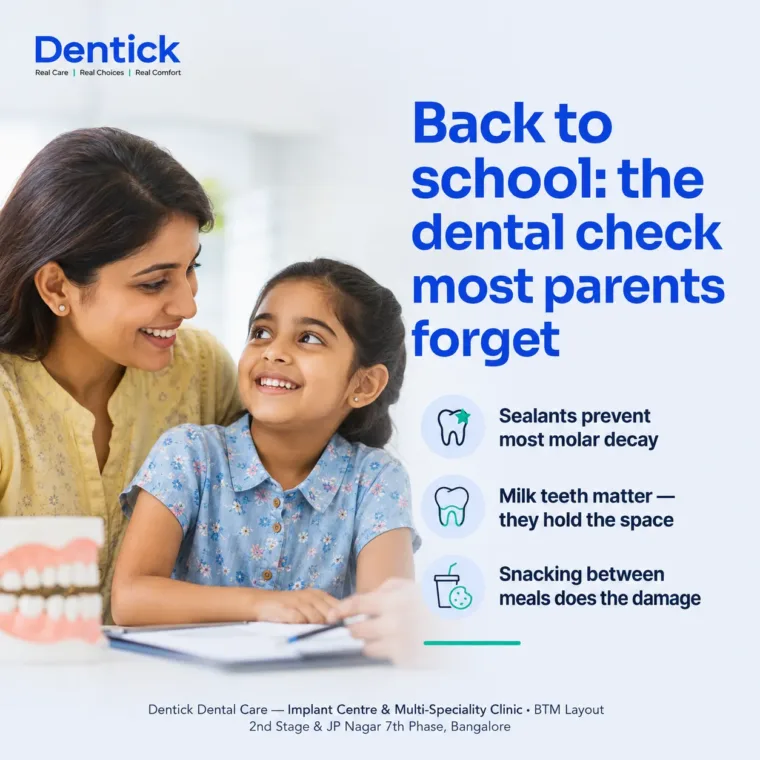
Sealants prevent most molar decay
Permanent molars arrive around age six with deep grooves across the biting surface. Those grooves are narrower than a toothbrush bristle, so they cannot be cleaned properly. And the overwhelming majority of childhood decay starts in them.
A fissure sealant is a thin resin coating flowed into the grooves and set with a light. No drilling, no injection, no discomfort, and it takes a few minutes per tooth. The evidence for it is strong and long-standing. It is the highest-value preventive treatment in children’s dentistry and it is routinely not offered because nobody asked. Ask about it when the first permanent molars come through, around age six or seven. And again when the second molars arrive around twelve.
Milk teeth matter — they hold the space
The belief that decay in milk teeth does not matter because they fall out anyway is common and wrong in two specific ways.
First, they hold the space for the permanent teeth developing beneath them. A milk molar lost early lets the teeth behind drift forward, closing the gap the adult tooth needed. And that is a direct route to crowding and a longer orthodontic treatment later. Second, infection in a milk tooth sits directly above the developing permanent tooth and can affect its enamel formation. Beyond that, a child in pain does not sleep or eat well. Treating a milk tooth is not wasted money.
Snacking between meals does the damage
Frequency of sugar exposure matters more than the total quantity, which is the opposite of what most people assume. Each exposure drops the pH in the mouth for around twenty to thirty minutes while saliva neutralises it.
So a chocolate eaten in one sitting after a meal does far less damage than the same chocolate eaten in pieces across an afternoon, which keeps the mouth acidic almost continuously. The practical advice that actually works: keep sweets to mealtimes, water between meals rather than juice or flavoured milk. And never a sugary drink in a bottle at bedtime. Sticky and slow-dissolving items — toffees, dried fruit, boiled sweets — are worse than their sugar content suggests because of how long they stay in contact.
An early orthodontic assessment saves cost later
An orthodontic assessment around age seven is standard practice internationally and rarely happens here. It is not about starting braces at seven — most children need nothing at that stage.
What it identifies is the small set of problems that are much easier and cheaper to intervene in while the jaw is still growing: crossbites, severe crowding, a significantly protruding upper jaw, or a thumb-sucking habit that is deforming the arch. Correcting a crossbite at eight can take a few months with a simple appliance. Correcting the same problem at eighteen can require extractions or surgery. Most assessments end with “review in a year”, which is a perfectly good outcome and costs a consultation.
Make it routine, not an emergency
The strongest predictor of an adult who avoids dentists is a childhood in which the only dental visits were emergencies. Every appointment is then associated with pain, and the association is difficult to undo.
Bring children for check-ups when nothing is wrong, so the ordinary visit is boring rather than frightening. Six-monthly is right for most children. Let them sit in the chair, count teeth, and leave. Avoid telling them beforehand that it will not hurt — the word registers more than the reassurance. Our evening sessions until 8:30pm and full Sunday hours are the practical part of this: appointments that do not require pulling a child out of school make the routine visit far easier to sustain.
What it costs at Dentick
These are our current published prices for consultation & examination at both the BTM Layout 2nd Stage and JP Nagar 7th Phase clinics. You receive the full cost in writing before any treatment begins, and the written figure is the figure. The complete list for every treatment we offer is on our published price list.
| Treatment | Cost |
|---|---|
| Consultation & examination | ₹300 – ₹800 |
Frequently asked questions
When should a child first see a dentist?
By their first birthday, or within six months of the first tooth appearing. The first visits are largely about familiarisation and giving parents practical advice on cleaning and diet. Establishing the habit early is the point; there is rarely anything to treat.
Are dental sealants worth it?
Yes — they are among the best-evidenced preventive treatments in dentistry and prevent the majority of decay in the permanent molars where most childhood cavities start. They are quick, painless, need no injection, and cost a fraction of the filling they avoid. Ask about them when the first permanent molars come through.
Do cavities in baby teeth need treating?
Usually yes. They cause pain and infection, the infection can affect the developing permanent tooth beneath. And losing a baby molar early allows the neighbouring teeth to drift and close the space the adult tooth needs. The exception is a tooth already close to falling out naturally, where we may simply monitor it.
At what age should braces start?
Most fixed orthodontic treatment starts between eleven and fourteen, once most permanent teeth are through. But an assessment around age seven is worthwhile. Because a small number of problems — crossbites, severe crowding, jaw discrepancies — are dramatically easier to correct while growth is available. Most seven-year-olds need nothing but a review.
How do I stop my child being scared of the dentist?
Start visits before anything hurts, so the association is routine rather than emergency. Keep your own anxiety out of the conversation — children read it immediately. Avoid promising it will not hurt, since the word itself introduces the idea. Let them come along to your appointment first if that helps. And tell us at the start; we will pace it accordingly.
How much do dental sealants cost?
The price appears on the list published on this site. And it is a small fraction of the filling it prevents. Sealants are applied in minutes per tooth, need no injection and no drilling. And are usually done at a routine check-up rather than requiring a separate appointment. They should be checked at each visit, since they can chip over time and are simply reapplied.
When do children get their permanent teeth?
The first permanent molars and the lower front teeth arrive around age six, often without any baby tooth falling out first — which is why the six-year molars are so frequently missed. The rest follow gradually until around twelve, with wisdom teeth much later or never. The six-year molars are the ones to ask about sealing.
Is thumb sucking a problem?
It is normal in young children and most stop on their own. If it continues past about age four or five, once permanent teeth are on the way, it can push the upper front teeth forward and narrow the upper arch, producing problems that later need orthodontic correction. It is one of the specific things an assessment around age seven looks for. And stopping the habit early avoids the treatment.
Should my child use fluoride toothpaste?
Yes. Under three, a smear of 1,000ppm paste; from three to six, a pea-sized amount of 1,000 to 1,500ppm. Supervise brushing so it is spat out rather than swallowed in quantity, and do not rinse afterwards. Fluoride is the best-evidenced preventive measure available, and avoiding it entirely leaves a child materially more likely to need fillings.
What should I do if my child chips a tooth?
Find the fragment if you can and bring it — chips can sometimes be bonded straight back. Rinse the mouth gently, use a cold compress for swelling, and call us. If the chip exposes a pink or bleeding area in the middle of the tooth, that is the nerve and it needs seeing the same day. Even a chip that looks minor is worth checking, since trauma can affect the nerve weeks later.
How do I get my child to brush properly?
Supervise and assist until around age seven or eight — younger children do not have the dexterity to clean effectively however willing they are. Brush their teeth for them after they have had their turn. Use a timer or a two-minute song. Make it routine and unremarkable rather than a negotiation. And brush your own teeth alongside them, which works better than instruction.
Are dental treatments for children more expensive?
No — children's treatments generally cost less than the adult equivalent, and sealants in particular are inexpensive relative to what they prevent. A consultation is ₹300 as it is for adults. The economics of children's dentistry are strongly in favour of prevention, which is why we raise sealants and check-up intervals rather than waiting for something to treat.
If your child has permanent molars through and has never been offered sealants, that is worth a visit on its own. Evening and Sunday appointments mean no school missed — consultations start at ₹300.
Related reading
- Evening Dental Appointments in South Bangalore — Open Until 8:30pm, Seven Days
- Afraid of the Dentist? Read This Before You Cancel Another Appointment
- Why Does Cold Water Hurt One Tooth and Not the Others?
Book an appointment in BTM Layout or JP Nagar
Dentick Dental Care runs two clinics in South Bengaluru — BTM Layout 2nd Stage and JP Nagar 7th Phase. Open 24 hours, seven days a week. Consulting sessions run 11am–2pm and 5pm–8:30pm — book within those and you will be seen without waiting. Walk-ins and emergencies are attended at any hour, with a short wait outside session times. Evening sessions mean you do not need to take a weekday morning off. Read more about this treatment.
Call or WhatsApp +91 93538 45416 to book. Consultations start at ₹300 and include a written treatment plan with exact costs. We also serve patients from Koramangala, HSR Layout, Jayanagar, Bannerghatta Road, Arekere, Bommanahalli and Gottigere.
Have a question about your dental health? Ask us — no appointment needed, and it costs nothing.