 WhatsApp

Waking Up With a Sore Jaw? You May Be Grinding Your Teeth at Night
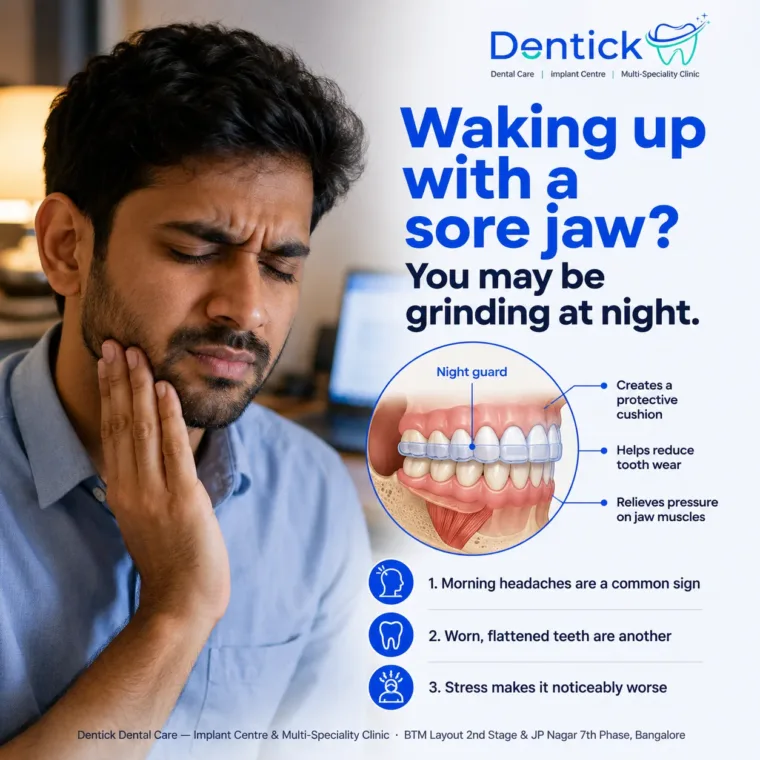
Grinding happens during sleep, so the person doing it is the last to know. It is generally identified one of two ways: a partner mentions the noise, or a dentist points out that the biting surfaces of your teeth have gone flat.
By the second route, some damage has already happened. Here is what to look for earlier, and what can actually be done about it.
The short answer: Waking with a sore jaw, morning headaches around the temples, or teeth that look increasingly flat are the common signs of nocturnal bruxism. It is usually stress-driven, most people are unaware they do it. And a custom night guard prevents the wear rather than treating it afterwards.
Morning headaches are a common sign
Waking with a dull, band-like headache across the temples is the classic sign. And it is routinely attributed to sleep quality or screen time instead. The temporalis is a jaw-closing muscle, and it has been working hard for hours.
The tell is the timing. A headache present on waking that eases through the morning points towards nocturnal muscle activity far more strongly than a headache that builds through the day. Jaw stiffness on waking, tenderness in front of the ear, a clicking jaw joint. And difficulty opening wide first thing all belong to the same picture. Some people also notice their teeth feel briefly loose or sensitive in the morning.
Worn, flattened teeth are another
Look at your lower front teeth and your canines in a mirror. Canines should come to a point. If yours have gone flat across the tip, that is wear, and it does not happen from chewing food.
Other visible signs: front teeth that look shorter than they used to, small chips along the biting edges, a translucent look at the edge of the upper front teeth where enamel has thinned, and hairline cracks. Fillings and crowns failing repeatedly for no obvious reason is another. Enamel does not regenerate, so all of this is cumulative — and it is why we mention grinding at check-ups even when the patient has noticed nothing. What we are trying to do is stop the next five years of it, not the last five.
Stress makes it noticeably worse
The link between stress and bruxism is well established. And most patients recognise it retrospectively — the grinding worsened during a difficult period at work, or after a move, or during a stretch of poor sleep.
Other contributors: caffeine and alcohol close to bedtime, smoking, certain medications including some antidepressants. And obstructive sleep apnoea, which has a genuine association with night-time grinding. That last one matters. If you also snore heavily, wake unrefreshed, or have been told you stop breathing during sleep, mention it — that is worth investigating on its own terms rather than only guarding the teeth against its consequences.
A night guard protects the teeth
A custom night guard is a hard acrylic splint made from an impression of your teeth, worn at night. It does not stop you grinding — nothing reliably does — but it puts a replaceable barrier between the upper and lower teeth. So the guard wears down instead of your enamel.
It also tends to reduce muscle activity and morning soreness by changing how the jaw closes. A custom guard fits precisely and stays in place. The boil-and-bite versions sold over the counter fit poorly, get chewed through quickly. And in some cases shift teeth because the coverage is uneven. If you are going to do this, have one made properly. Current pricing is on the price list published on this site.
Far cheaper than rebuilding worn teeth later
This is the straightforward economic case. A night guard is a modest one-off cost. Rebuilding worn teeth is not.
Once grinding has taken enough enamel, the fixes are crowns, onlays or composite build-ups across multiple teeth. And severe cases need full-mouth rehabilitation running into lakhs. Worn teeth also become sensitive as dentine is exposed. And the vertical height of the bite can reduce enough to change facial appearance. Every one of those outcomes is prevented by a device that costs a fraction of the repair. If you recognise two or more of the signs above, it is worth being looked at — it takes one appointment to know whether you are grinding. And the wear pattern tells us plainly.
What it costs at Dentick
These are our current published prices for night guard at both the BTM Layout 2nd Stage and JP Nagar 7th Phase clinics. You receive the full cost in writing before any treatment begins, and the written figure is the figure. The complete list for every treatment we offer is on our published price list.
| Treatment | Cost |
|---|---|
| Soft night guard (single arch) | ₹3,000 – ₹5,000 |
| Dual-laminate (hard-soft) night guard | ₹6,000 – ₹10,000 |
Frequently asked questions
How do I know if I grind my teeth at night?
The common indicators are morning jaw soreness or headaches, flattened or chipped tooth edges, increased sensitivity, a clicking jaw, and a partner hearing the noise. You cannot reliably self-diagnose it, but the wear pattern on your teeth is unmistakable to a dentist — we can usually tell you within a minute of looking.
Will a night guard stop me grinding?
Not usually — it protects rather than cures. The muscle activity generally continues, but the guard absorbs it instead of your enamel. And many patients find morning soreness improves considerably because the guard changes how the jaw closes. Addressing the underlying stress or sleep issue is what reduces the grinding itself.
Are over-the-counter night guards any good?
They are better than nothing for a short period, but not much. Boil-and-bite guards fit imprecisely, are chewed through within months, and uneven coverage can cause unwanted tooth movement over time. A custom guard made from an impression fits properly, lasts years, and does not shift your bite.
Can children grind their teeth?
Yes, and it is common in children — often during periods of change or when adult teeth are erupting. Most grow out of it and it rarely causes lasting damage to baby teeth. Mention it at a check-up so we can look at the wear. But it usually needs monitoring rather than a guard.
Does grinding cause TMJ problems?
It can contribute. Sustained overload of the jaw joint and its muscles is associated with clicking, restricted opening and pain in front of the ear. Not everyone who grinds develops joint problems. And not all jaw joint pain comes from grinding — which is why it is worth having assessed rather than assumed.
How much does a night guard cost in Bangalore?
The current price is on the price list published on this site, with a soft single-arch guard costing less than a dual-laminate hard-soft one. Either is a fraction of what rebuilding worn teeth costs. It takes two appointments — an impression or scan, then fitting a week or two later — and you get the cost in writing beforehand.
How long does a night guard last?
Two to five years for most people, and heavy grinders wear through one faster. That is the guard doing its job: the wear it absorbs would otherwise have gone into your enamel. Bring it to your check-ups so we can assess it — a guard worn through in places is no longer protecting evenly. And a cracked one can shift teeth.
How do I clean a night guard?
Rinse it in cool water and brush it with a soft brush and mild soap each morning, then let it dry completely before storing it in its ventilated case. Never use hot water, which distorts the material permanently. A denture cleaning tablet once a week deals with build-up. Storing a damp guard in a closed case is what causes the smell and the bacterial growth people complain about.
Does a night guard cause more grinding?
No, though many people notice the grinding more at first simply because they are aware of the device. The muscle activity generally continues at a similar level; the guard changes what it acts on. A poorly fitting over-the-counter guard can worsen jaw discomfort because coverage is uneven. Which is a reasonable argument for a custom one.
Can Botox help with teeth grinding?
Injections into the masseter muscle are used in some settings to reduce clenching force. And there is a body of evidence behind it. It is not first-line, it is not permanent, and it does not address why the grinding is happening. For most patients a custom night guard plus attention to stress and sleep quality does the job at far lower cost. If you have severe bruxism that a guard is not controlling, it is a conversation to have with a specialist.
Is teeth grinding linked to sleep apnoea?
There is a well-documented association. If you also snore heavily, wake unrefreshed, have morning headaches, or have been told you stop breathing during sleep, that combination is worth investigating on its own terms — untreated sleep apnoea has significant health consequences beyond your teeth. We would refer you for a sleep assessment rather than only fitting a guard.
Will a night guard fix my jaw clicking?
Sometimes it helps, by reducing the load on the joint and its muscles. But a clicking jaw has several possible causes and grinding is only one. Clicking without pain or restricted opening often needs monitoring rather than treatment. Clicking with pain, locking, or difficulty opening should be assessed properly before assuming a guard is the answer.
If you wake with a sore jaw or headaches, a check-up will settle whether grinding is the cause — the wear pattern is visible long before you would notice it yourself. Consultations start at ₹300 at either clinic.
Related reading
- Spit, Don't Rinse: The Three-Second Brushing Habit That Changes Everything
- Why Does Cold Water Hurt One Tooth and Not the Others?
Book an appointment in BTM Layout or JP Nagar
Dentick Dental Care runs two clinics in South Bengaluru — BTM Layout 2nd Stage and JP Nagar 7th Phase. Open 24 hours, seven days a week. Consulting sessions run 11am–2pm and 5pm–8:30pm — book within those and you will be seen without waiting. Walk-ins and emergencies are attended at any hour, with a short wait outside session times. Evening sessions mean you do not need to take a weekday morning off. Read more about this treatment.
Call or WhatsApp +91 93538 45416 to book. Consultations start at ₹300 and include a written treatment plan with exact costs. We also serve patients from Koramangala, HSR Layout, Jayanagar, Bannerghatta Road, Arekere, Bommanahalli and Gottigere.
Have a question about your dental health? Ask us — no appointment needed, and it costs nothing.