 WhatsApp

Implant or Bridge for One Missing Tooth? An Honest Comparison
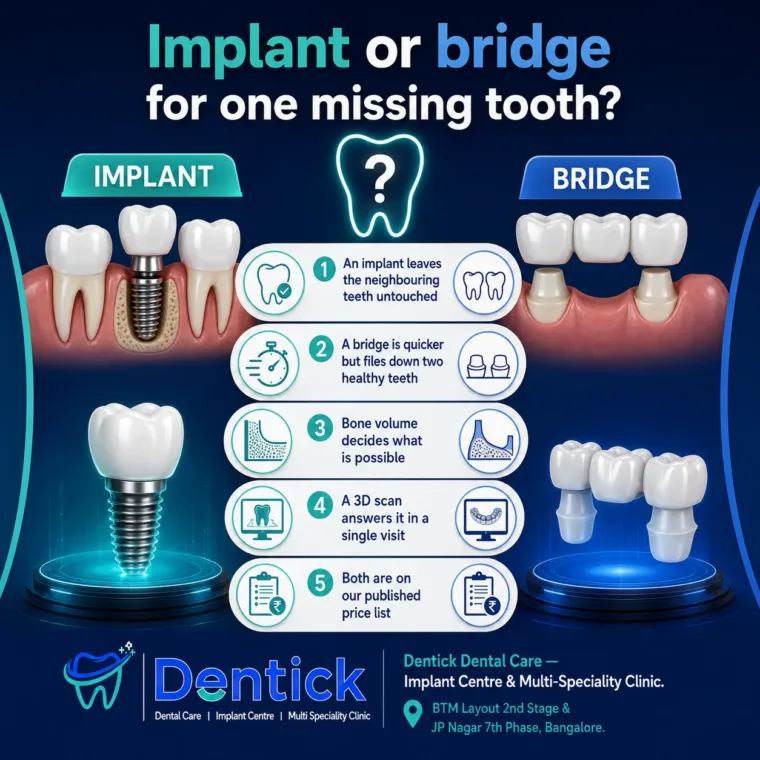
One missing tooth, two established ways to replace it, and a decision most people make on price alone. Price is a reasonable input. It is just not the only one. And the difference that matters most is what each option does to the teeth on either side.
Here is how we actually talk this through with patients at our BTM Layout and JP Nagar clinics — including the cases where a bridge is genuinely the better answer, which do exist.
The short answer: An implant replaces the tooth without touching its neighbours and preserves the bone underneath, but costs more and takes months. A bridge is faster and cheaper but requires filing down two healthy adjacent teeth. Where there is adequate bone and the neighbouring teeth are sound, an implant is usually the better long-term choice.
An implant leaves the neighbouring teeth untouched
An implant is a standalone tooth. A titanium fixture goes into the bone where the root used to be. And a crown goes on top of it. The teeth either side are not involved at all — not filed, not crowned, not loaded.
That matters most when those neighbours are healthy and unrestored. Filing down a virgin tooth to carry a bridge is an irreversible decision. And it puts that tooth on a path towards needing a root canal at some point — the published figures for pulp death in bridge abutment teeth are not trivial. If the teeth either side of your gap have never been touched, that is a strong argument for the implant.
A bridge is quicker but files down two healthy teeth
A three-unit bridge spans the gap by crowning both neighbours and suspending a false tooth between them. It is well-proven, it can be done in two to three weeks rather than months, and it costs less upfront.
The cost is the two healthy teeth. They are reduced substantially to make room for the crowns, and that reduction is permanent. There is also a maintenance consideration people are rarely warned about: you cannot floss between bridged units normally. And cleaning underneath the false tooth with a threader or interdental brush becomes a daily requirement. Bridges most often fail not because the bridge breaks but because decay starts at the margin of one of the supporting crowns.
Bone volume decides what is possible
This is the constraint that overrules preference. Bone starts resorbing the moment a tooth is lost, most rapidly in the first year. And an implant needs sufficient bone volume and density to be placed safely.
If you lost the tooth recently, you almost certainly have enough. If it has been missing for five years, you may need a graft first — which adds cost and several months. In the upper back jaw the sinus sits close above, and a sinus lift may be needed. None of this rules an implant out; it changes the timeline and the price. It is also the strongest argument for not deferring the decision indefinitely. Because the option quietly gets more expensive the longer the gap stays empty.
A 3D scan answers it in a single visit
A CBCT scan settles it. It shows bone height, width and density in three dimensions, exactly where the nerve canal runs in the lower jaw. And how low the sinus sits in the upper. From that we can tell you in the same visit whether a standard implant is possible, whether you need a graft, and what each route costs.
What this replaces is guesswork. Planning an implant from a flat OPG X-ray means finding out about a bone deficiency during surgery rather than before it. And that is how people end up with a price that changes mid-treatment. We will not quote an implant without the scan.
Both are on our published price list
Both appear on the price list published on this site, with no separate consultation quote required to see them. A single implant including the crown is ₹35,000 to ₹45,000. Bridge pricing depends on the crown material, and the full range is on the price list.
Set against each other over twenty years, the gap narrows more than people expect: a bridge typically needs replacing after ten to fifteen years, and each replacement costs again. An implant fixture is designed to be permanent, with the crown as the wearing part. That is not an argument that an implant is always right — it is an argument that comparing the two on today’s price alone gives you the wrong answer.
What it costs at Dentick
These are our current published prices for dental implant at both the BTM Layout 2nd Stage and JP Nagar 7th Phase clinics. You receive the full cost in writing before any treatment begins, and the written figure is the figure. The complete list for every treatment we offer is on our published price list.
| Treatment | Cost |
|---|---|
| Regular implant system (per implant, includes crown) | ₹35,000 – ₹40,000 |
| Imported implant system (per implant, includes crown) | ₹40,000 – ₹45,000 |
Frequently asked questions
Is a bridge ever better than an implant?
Yes, in several situations. If the teeth either side already need crowns, a bridge uses work you were going to do anyway. If there is severe bone loss and you would rather not have grafting. If you need the gap closed in weeks rather than months for a specific reason. And if a medical condition or heavy smoking makes implant success materially less predictable. We will tell you when that is your case.
How long does each option take?
A bridge takes two to three weeks and two to three visits. An implant takes three to six months in total. Because the fixture must integrate with bone before the crown is loaded. Although a temporary tooth can usually fill the gap in the meantime. If the gap is visible when you smile, you will not be walking around with a space.
What happens if I just leave the gap?
The bone under the gap resorbs, the neighbouring teeth drift and tilt into the space. And the opposing tooth over-erupts downwards. Over years this changes your bite and makes any future replacement more complex and more expensive. A single back tooth is the one people most often leave — and it is also the most common reason a straightforward implant becomes a graft case.
Which lasts longer, an implant or a bridge?
Implant fixtures show survival above 90% at ten years and many last decades. Bridges typically last ten to fifteen years before needing replacement, usually because of decay at a crown margin rather than fracture. Both depend far more on cleaning than on which was chosen.
Can I get an implant years after losing the tooth?
Usually yes, but often with a bone graft first, which adds three to six months and additional cost. There is no time limit that makes it impossible. The scan tells us what your specific site needs — and quite often patients who assumed they had waited too long turn out to have enough bone.
How do the costs compare between an implant and a bridge?
A single implant including the crown is ₹35,000 to ₹45,000 at Dentick. A three-unit bridge costs less upfront, with the exact figure depending on the crown material and shown on the published price list. Over twenty years the gap narrows considerably. Because a bridge typically needs replacing after ten to fifteen years and each replacement costs again. While an implant fixture is designed to be permanent with only the crown as a wearing part.
What is a Maryland bridge?
A conservative type of bridge that bonds a false tooth to the back of one or both neighbouring teeth with thin metal or ceramic wings, rather than crowning them. Its great advantage is that it removes very little tooth structure. Its limitation is that it is less strong and can debond. So it suits front teeth and light bites far better than molars. For a young patient who has lost a front tooth and is not yet ready for an implant, it is often the right interim answer.
Can a bridge replace more than one missing tooth?
Yes, but the span matters. Two adjacent missing teeth can often be bridged from the teeth either side. Beyond that, the supporting teeth are carrying a load they were not designed for. And the risk of failure rises sharply. For longer gaps an implant-supported bridge — where implants rather than natural teeth carry the span — is the more predictable answer. And it protects the remaining teeth entirely.
Which hurts more, an implant or a bridge?
Neither should hurt at the time; both are done under local anaesthetic. An implant involves minor surgery, so expect two to three days of swelling and soreness afterwards, managed with ordinary painkillers. A bridge involves no surgery, but the teeth being prepared can be sensitive for a period afterwards, particularly to cold, until the permanent bridge is cemented. Most patients report the implant as the more uncomfortable of the two for a few days and then entirely forgotten.
Which is easier to clean?
An implant, clearly. It is cleaned like a natural tooth, with a brush and an interdental brush or floss around it. A bridge cannot be flossed normally between the units. So cleaning underneath the false tooth requires a threader or a specific interdental brush every day — and bridges most often fail because decay starts at the margin of a supporting crown, which is a cleaning problem. If you know you will find that daily routine difficult, it is a genuine argument for the implant.
What if I cannot afford either option right now?
Tell us, because the sensible answer depends on which tooth it is. For some back teeth, monitoring the gap for a period is reasonable. For others, a removable partial denture is an inexpensive interim that holds the space and stops the neighbouring teeth drifting, which protects your future options. What is worth avoiding is leaving a gap indefinitely without a plan, since bone loss and tooth drift quietly make the eventual replacement more complex and more expensive.
Do dental implants set off airport metal detectors?
No. Titanium is not ferromagnetic and the quantity in a dental implant is far too small to trigger a walk-through detector. Implants are also safe with MRI scanning. If you are having a head or neck MRI, mention any dental work anyway — metal crowns and orthodontic appliances can cause image distortion. Though they are not a safety problem.
Bring the question in and we will scan the site and cost both routes properly, side by side. You will leave with two written numbers and a clear recommendation, and no pressure to take the more expensive one.
Related reading
- What a Dental Implant Actually Costs in Bangalore (2026 Price Breakdown)
- 5 Things Nobody Tells You Before Getting a Dental Implant
- The First 48 Hours After Dental Implant Surgery: What to Expect
Book an appointment in BTM Layout or JP Nagar
Dentick Dental Care runs two clinics in South Bengaluru — BTM Layout 2nd Stage and JP Nagar 7th Phase — open 11am–2pm and 5pm–8:30pm, seven days a week including Sunday. Evening appointments mean you do not need to take a weekday morning off. And we answer the phone 24/7 for genuine emergencies. Read more about this treatment.
Call or WhatsApp +91 93538 45416 to book. Consultations start at ₹300 and include a written treatment plan with exact costs. We also serve patients from Koramangala, HSR Layout, Jayanagar, Bannerghatta Road, Arekere, Bommanahalli and Gottigere.
Have a question about your dental health? Ask us — no appointment needed, and it costs nothing.