 WhatsApp

The First 48 Hours After Dental Implant Surgery: What to Expect
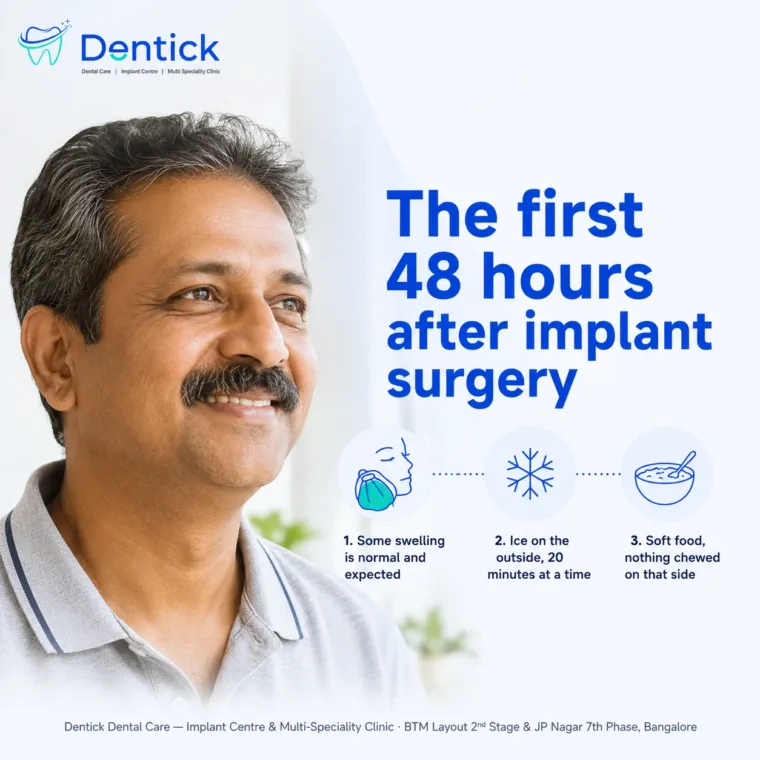
Implant placement is usually less unpleasant than patients expect. The two days afterwards are the part worth preparing for — not because they are difficult. But because knowing what is normal stops you worrying about things that are.
This is what we tell every implant patient at our BTM Layout and JP Nagar clinics before they leave the chair.
The short answer: Swelling peaking around 48 hours is normal and expected after implant surgery. Apply ice to the outside of the face in 20-minute intervals for the first day, eat soft food avoiding the surgical side. And do not disturb the site. Pain that increases after day two is the sign to call.
Some swelling is normal and expected
Swelling begins a few hours after surgery, builds through day one, and peaks somewhere around 48 hours before receding. Peak swelling on day two is not deterioration — it is the expected curve. And it catches people out because they assume each day should be better than the last.
Some bruising on the cheek or under the jaw is also normal and can appear a day or two later, sometimes tracking downwards under gravity. It looks worse than it is. Mild oozing on the first evening is expected. What is not expected is swelling that is still increasing on day four, or swelling that spreads towards the eye or under the jaw — that is a call, not a wait.
Ice on the outside, 20 minutes at a time
Ice on the outside of the face over the surgical area, twenty minutes on and twenty minutes off, for the first 24 hours. Not directly against the skin — wrap it.
Cold constricts blood vessels and genuinely limits how much swelling develops, but the window is short. After the first day ice does very little. And from day three gentle warmth is more helpful for resolving what is already there. Sleep with your head elevated on an extra pillow for the first two nights. Lying flat increases blood pressure at the site and makes both swelling and throbbing worse. Take the painkillers we have prescribed on schedule for the first day rather than waiting for pain to arrive — staying ahead of it works better than catching up.
Soft food, nothing chewed on that side
Soft, cool food for the first 24 hours, and nothing chewed on the surgical side for considerably longer. Curd, dal, mashed rice, khichdi cooled down, smoothies eaten with a spoon.
No straws for at least three days — the suction disturbs healing at the site. Nothing hot on day one, since heat can restart bleeding. Avoid anything with small hard particles that can lodge in the surgical site: nuts, seeds, popcorn, chips. Reintroduce texture gradually over the following week, still favouring the other side. And no smoking — nicotine constricts the blood supply the site needs to heal. And smoking is the largest single risk factor for early implant failure. If you smoke, the first 72 hours matter most and two weeks is far better.
Do not disturb the site with your tongue
The instinct to explore the site with your tongue is strong and worth resisting. So is lifting the lip to inspect it in a mirror repeatedly, which stretches the tissue at the sutures.
Do not rinse at all on day one. From day two, gentle warm salt water rinses several times a day — let it move across the area rather than swishing forcefully. Brush the rest of your mouth normally that same evening. And keep the brush away from the surgical site itself for a few days, then resume gently with a soft brush. Keeping the rest of your mouth clean actively helps by reducing the bacterial load. If you have been given a chlorhexidine mouthwash, use it for the course prescribed and then stop.
Call us if pain increases after day two
The reliable signal is direction of travel. Pain that peaks on day one or two and then steadily improves is normal recovery. Pain that is improving and then gets worse from day three onwards is not. And it is the pattern that warrants a call.
Also call for: bleeding that restarts properly after the first day, swelling still increasing on day four, a bad taste or discharge, fever, numbness that has not resolved several hours after the anaesthetic should have worn off, or a suture that has come away early. None of these are common, and most are straightforward to deal with when caught early. We answer 24/7 on +91 93538 45416, and asking is always better than waiting to see. If swelling involves the eye or the floor of the mouth, or you have difficulty swallowing or breathing, treat that as a hospital emergency.
What it costs at Dentick
These are our current published prices for dental implant at both the BTM Layout 2nd Stage and JP Nagar 7th Phase clinics. You receive the full cost in writing before any treatment begins, and the written figure is the figure. The complete list for every treatment we offer is on our published price list.
| Treatment | Cost |
|---|---|
| Regular implant system (per implant, includes crown) | ₹35,000 – ₹40,000 |
| Imported implant system (per implant, includes crown) | ₹40,000 – ₹45,000 |
Frequently asked questions
How long does pain last after dental implant surgery?
Most patients need painkillers for two to three days, with the worst of it on day one and two. By day four or five, discomfort is usually mild or gone. Multiple implants or a bone graft extend this somewhat. Pain that is increasing after day two is the exception that needs checking.
When can I go back to work after an implant?
Most people return the next day for a single straightforward implant. Take the day of surgery off, and expect to look slightly swollen for two to three days. For multiple implants, grafting or sinus lift procedures, allow two to three days. Avoid heavy exercise and lifting for at least three to five days, since raised blood pressure can restart bleeding.
Is swelling after implant surgery normal?
Yes, and it peaks around 48 hours rather than immediately — which is why day two often feels like a step backwards. Bruising on the cheek or jaw is also normal and may appear late. What is not normal is swelling still increasing after day three, or swelling spreading towards the eye or throat.
Can I brush my teeth after implant surgery?
Brush the rest of your mouth normally the same evening — this helps rather than hinders. Keep the brush off the surgical site for a few days, then resume gently with a soft brush. Start gentle warm salt water rinses from day two, never on day one.
What if a stitch comes out early?
It is usually not an emergency, but call us and let us know. Many implant sutures are designed to dissolve within one to two weeks anyway. If the site opens or you can see the healing cap or bone, we would want to see you sooner rather than later.
Can I take ibuprofen after implant surgery?
Follow whatever we have prescribed, which is usually a combination taken on schedule for the first day rather than waited for. Ibuprofen is generally effective for post-surgical dental pain because the problem is inflammatory, assuming no medical reason you should not take it. Tell us about stomach ulcers, kidney problems, asthma or blood thinners before surgery, since they change what we prescribe.
When can I brush over the implant site?
Brush the rest of your mouth normally the same evening — keeping the overall bacterial load down actively helps the site heal. Keep the brush off the surgical area itself for around three to five days, then resume gently with a soft brush. Start gentle warm salt water rinses from day two, never day one. If a chlorhexidine mouthwash has been prescribed, use it for the full course and then stop.
Is numbness after implant surgery normal?
Numbness from the local anaesthetic wears off within a few hours. Numbness or tingling in the lip or chin that persists beyond that — particularly after a lower jaw implant — should be reported to us the same day. It is uncommon, especially where a CBCT scan has mapped the nerve position in advance, and early assessment matters. Do not wait to see whether it resolves on its own.
Can I use a straw or water flosser after implant surgery?
No straws for at least three days — suction disturbs the healing site. A water flosser should be kept away from the surgical area for the first two weeks. And then used on a low setting. Once the site has healed and the crown is fitted, a water flosser becomes genuinely useful for daily maintenance around the implant.
What should I do about the temporary tooth?
If you have a removable temporary, take it out at night and clean it separately. And expect it to feel less stable than a final crown — it is not designed to load the implant. Avoid chewing on it. If it rubs the surgical site or feels like it is pressing on the healing area, come in for an adjustment rather than persevering. Pressure on a healing implant site is exactly what you want to avoid.
How soon can I have the crown fitted?
Three to six months after placement in most cases, once we have confirmed the implant has integrated with the bone. Lower jaw sites are usually at the faster end, upper jaw and grafted sites at the slower. It is checked rather than assumed — loading an implant that has not fully integrated is a common cause of failure. And the wait is what makes the result permanent.
Is bruising after implant surgery normal?
Yes, and it can appear a day or two later and track downwards under gravity, sometimes reaching the jawline or neck. It looks considerably worse than it is and fades over a week to ten days. What is not expected is bruising with increasing swelling after day three, fever, or a spreading firm area — those warrant a call on +91 93538 45416.
If anything about your recovery does not match what is described here, call rather than search — +91 93538 45416, answered at any hour. A short conversation usually settles it.
Related reading
- What a Dental Implant Actually Costs in Bangalore (2026 Price Breakdown)
- Implant or Bridge for One Missing Tooth? An Honest Comparison
- 5 Things Nobody Tells You Before Getting a Dental Implant
Book an appointment in BTM Layout or JP Nagar
Dentick Dental Care runs two clinics in South Bengaluru — BTM Layout 2nd Stage and JP Nagar 7th Phase. Open 24 hours, seven days a week. Consulting sessions run 11am–2pm and 5pm–8:30pm — book within those and you will be seen without waiting. Walk-ins and emergencies are attended at any hour, with a short wait outside session times. Evening sessions mean you do not need to take a weekday morning off. Read more about this treatment.
Call or WhatsApp +91 93538 45416 to book. Consultations start at ₹300 and include a written treatment plan with exact costs. We also serve patients from Koramangala, HSR Layout, Jayanagar, Bannerghatta Road, Arekere, Bommanahalli and Gottigere.
Have a question about your dental health? Ask us — no appointment needed, and it costs nothing.