 WhatsApp

5 Things Nobody Tells You Before Getting a Dental Implant
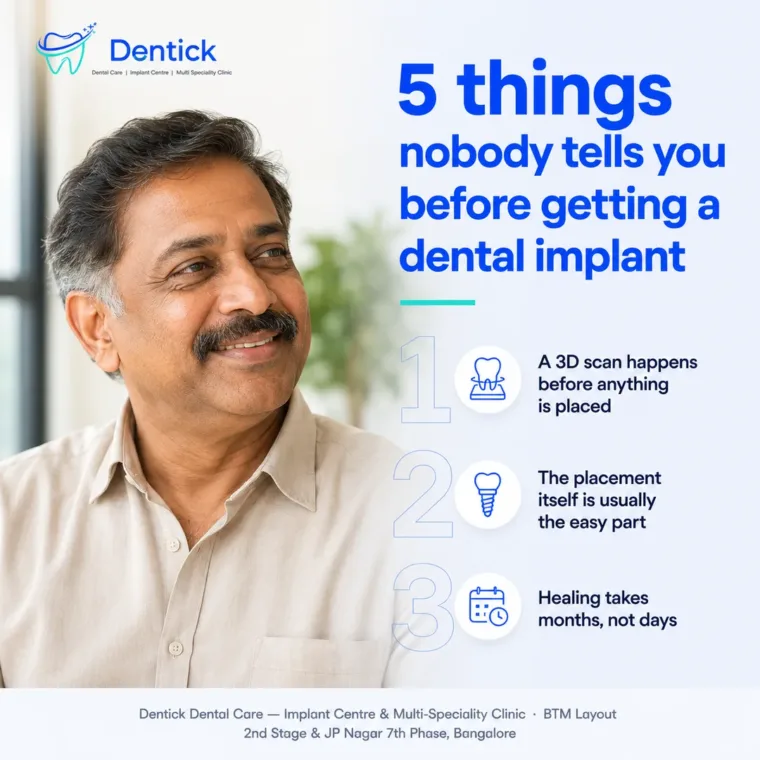
People arrive expecting an implant to be like a filling: come in, have it done, leave with a tooth. The reality is a staged process spread over months, and knowing that upfront changes how you plan around it.
None of what follows is a warning. Implants are the most predictable tooth replacement available and we place them every week at both clinics. It is simply the version of the process we would want explained to us.
The short answer: A dental implant is not a single appointment. It is a 3D scan, a surgical placement, three to six months of healing while the implant fuses to bone. And a second visit for the crown. The surgery is usually the easiest part of the process.
A 3D scan happens before anything is placed
Before anything is placed, we take a CBCT scan — a three-dimensional X-ray of your jaw. It takes under a minute and it decides everything that follows.
What we are looking at is bone height, bone width, bone density, exactly where the inferior alveolar nerve runs in the lower jaw. And how low the maxillary sinus sits in the upper. From that we plan the implant’s length, width, angle and position before you are in the chair. Planning an implant from a flat OPG is possible and was standard for years. But it means discovering problems during surgery. The scan is also what makes the quote reliable — it is how we know whether you need a graft before we tell you the price.
The placement itself is usually the easy part
The surgery surprises almost everyone. Under local anaesthetic, placing a single implant takes around thirty to forty-five minutes and most patients describe it as less unpleasant than the extraction that preceded it. There is pressure and vibration, no pain.
Afterwards, expect swelling that peaks around day two, some soreness for three or four days. And ordinary painkillers to be sufficient. Most people are back at work the next day. The genuinely difficult part of an implant is not the appointment you were dreading — it is the waiting that comes after it, which nobody dreads and everybody underestimates.
Healing takes months, not days
Osseointegration — bone growing into the implant surface and locking it in place — takes three to six months. It cannot be rushed, and loading an implant before it has integrated is how implants fail.
Lower jaw sites are usually at the faster end, upper jaw and grafted sites at the slower. If you had a bone graft or sinus lift first, add several months again before the implant itself goes in. This is why anyone planning around a wedding or a move abroad should start the conversation nine to twelve months ahead, not three. During this period you are not toothless — a temporary crown or a removable tooth fills a visible gap.
The crown comes later, at a second visit
Once integration is confirmed, you come back for the abutment and the crown. This involves an impression or a digital scan, then the crown is made in a lab over one to two weeks, then fitted.
The crown is where the aesthetics are decided — shade, shape, how it emerges from the gum — and it is worth spending time on if it is a front tooth. We will check it in your mouth before it is finally cemented. And if the shade is not right, it goes back. This is also the visit where a lot of the cost sits. Which is why quotes that exclude the crown are so misleading: you are not most of the way to a finished tooth when the fixture is placed.
It needs cleaning like a natural tooth, forever
An implant cannot decay. What it can do is lose the bone around it. And peri-implantitis is the single largest cause of implants failing years after successful placement.
It behaves like gum disease: plaque accumulates at the junction of implant and gum, inflammation follows. And bone is lost — often painlessly, until the implant is loose. Prevention is ordinary and unglamorous: brush it like a natural tooth, clean underneath and around it with an interdental brush or water flosser daily. And keep six-monthly reviews so we can measure the bone level around it while any change is still reversible. Smoking materially increases the risk. An implant is a permanent fixture that requires permanent maintenance, and that is the part people are least often told.
What it costs at Dentick
These are our current published prices for dental implant at both the BTM Layout 2nd Stage and JP Nagar 7th Phase clinics. You receive the full cost in writing before any treatment begins, and the written figure is the figure. The complete list for every treatment we offer is on our published price list.
| Treatment | Cost |
|---|---|
| Regular implant system (per implant, includes crown) | ₹35,000 – ₹40,000 |
| Imported implant system (per implant, includes crown) | ₹40,000 – ₹45,000 |
Frequently asked questions
How long does the whole dental implant process take?
Typically three to six months from placement to final crown for a straightforward case. Add three to six months if you need a bone graft or sinus lift first. Immediate loading — a temporary crown on the same day — is possible in selected cases with good bone stability. But it is not suitable for everyone and should not be promised before the scan.
Will I have a gap while the implant heals?
Not a visible one. For front teeth we provide a temporary — either a removable partial or a temporary bridge — for the healing period. For back teeth, many people choose to leave it, since it is not visible and eating is unaffected. Either way, tell us if the appearance matters to you and we will plan for it.
What can make a dental implant fail?
Smoking is the largest modifiable factor. Uncontrolled diabetes, poor oral hygiene leading to peri-implantitis, heavy grinding without a night guard. And insufficient bone at placement are the others. Failures in the first few months are usually integration problems; failures years later are almost always bone loss from plaque. Both are far more about maintenance than about the implant itself.
Am I too old for a dental implant?
There is no upper age limit. What matters is bone volume and general health, not the number. We place implants routinely in patients in their seventies. The relevant questions are whether you are on bisphosphonates or blood thinners, whether diabetes is well controlled. And whether you can manage the daily cleaning — all of which we go through at the consultation.
Does the implant look like a real tooth?
A well-made implant crown is difficult to distinguish from a natural tooth, particularly on back teeth. Front teeth are more demanding because the gum contour and the way the crown emerges from it matter as much as the shade. This is exactly where taking the extra visit to check the crown before cementing is worth it. And we would rather send one back than fit something you are not happy with.
What is osseointegration?
It is the process by which living bone grows directly onto the surface of the titanium implant and locks it in place. It takes three to six months and it is what makes an implant function like a root rather than a screw sitting in a hole. It cannot be accelerated, and loading an implant before integration is complete is one of the main causes of early failure — which is why the crown is deliberately fitted at a second visit months later.
What is a bone graft or sinus lift?
Both create the bone volume an implant needs where there is not enough. A graft adds material to a ridge that has resorbed after tooth loss. A sinus lift raises the floor of the maxillary sinus in the upper back jaw, where the sinus often sits too low for an implant to be placed safely. Both add cost and three to six months to the timeline. And both appear in the written plan before anything begins rather than being discovered mid-treatment.
Can I have an MRI scan with dental implants?
Yes. Titanium is not ferromagnetic and dental implants are considered MRI-safe. They may cause some local image distortion on a head or neck scan. So mention them to the radiographer, along with any metal crowns or orthodontic retainers. They will not trigger airport security either.
What is peri-implantitis?
Inflammation and progressive bone loss around an implant, driven by plaque accumulating at the junction of implant and gum. It behaves much like gum disease and it is the single largest cause of implants failing years after successful placement. It is usually painless until the implant is loose. Which is why six-monthly reviews measuring the bone level matter — caught early, it is treatable; caught late, it is not. Smoking substantially increases the risk.
How do I clean a dental implant?
Brush it exactly as you would a natural tooth, twice a day. And clean around and underneath it daily with an interdental brush sized to the space. A water flosser is a useful addition but does not replace bristles. The critical area is the junction where the crown meets the gum. An implant cannot decay, so the entire maintenance question is about keeping that junction free of plaque — and it is a permanent requirement, not a settling-in period.
Can smokers have dental implants?
Yes, but with a clearly higher failure rate, and you should be told that plainly before deciding. Nicotine constricts the blood supply the site needs to heal and smokers have significantly higher rates of both early failure and later peri-implantitis. Stopping for two weeks before and eight weeks after placement makes a measurable difference. We will not refuse to treat you for smoking — we will make sure the decision is informed.
What happens if an implant fails?
The implant is removed, which is usually straightforward if it has not integrated. The site is allowed to heal, often with a graft, and a replacement can generally be placed after several months. It is not the end of the road, though it costs time. Early failures are usually integration problems; late failures are almost always peri-implantitis from plaque. Discuss what the practice does in the event of failure before you commit — it is a fair question and you should get a clear answer.
If you are considering an implant, the useful first step is the scan and a written plan — you will know the timeline, the total cost and whether you need a graft before committing to anything. Consultations start at ₹300.
Related reading
- What a Dental Implant Actually Costs in Bangalore (2026 Price Breakdown)
- Implant or Bridge for One Missing Tooth? An Honest Comparison
- The First 48 Hours After Dental Implant Surgery: What to Expect
Book an appointment in BTM Layout or JP Nagar
Dentick Dental Care runs two clinics in South Bengaluru — BTM Layout 2nd Stage and JP Nagar 7th Phase. Open 24 hours, seven days a week. Consulting sessions run 11am–2pm and 5pm–8:30pm — book within those and you will be seen without waiting. Walk-ins and emergencies are attended at any hour, with a short wait outside session times. Evening sessions mean you do not need to take a weekday morning off. Read more about this treatment.
Call or WhatsApp +91 93538 45416 to book. Consultations start at ₹300 and include a written treatment plan with exact costs. We also serve patients from Koramangala, HSR Layout, Jayanagar, Bannerghatta Road, Arekere, Bommanahalli and Gottigere.
Have a question about your dental health? Ask us — no appointment needed, and it costs nothing.